Why Big Companies Invest Millions in Training — And What Small Agencies Can Learn
Why the world's largest employers treat training as a competitive weapon and what every Medicare agency leader can take from their playbook.
Topics discussed in this Blog:
Welcome Back
My Personal Experience
What Big Companies Are Actually Doing
Why They're Doing It — The Business Case Behind the Investment
"That's for Billion-Dollar Companies. I Run a Small Agency."
What You Can Borrow (Right Now)
The Principle That Scales to Any Size
The Bottom Line
Ready to Build Your Training Strategy?
Welcome Back
Welcome back to the Insurance Training HQ Newsletter and our blog series, "Why Training Is So Important to Agency Success."
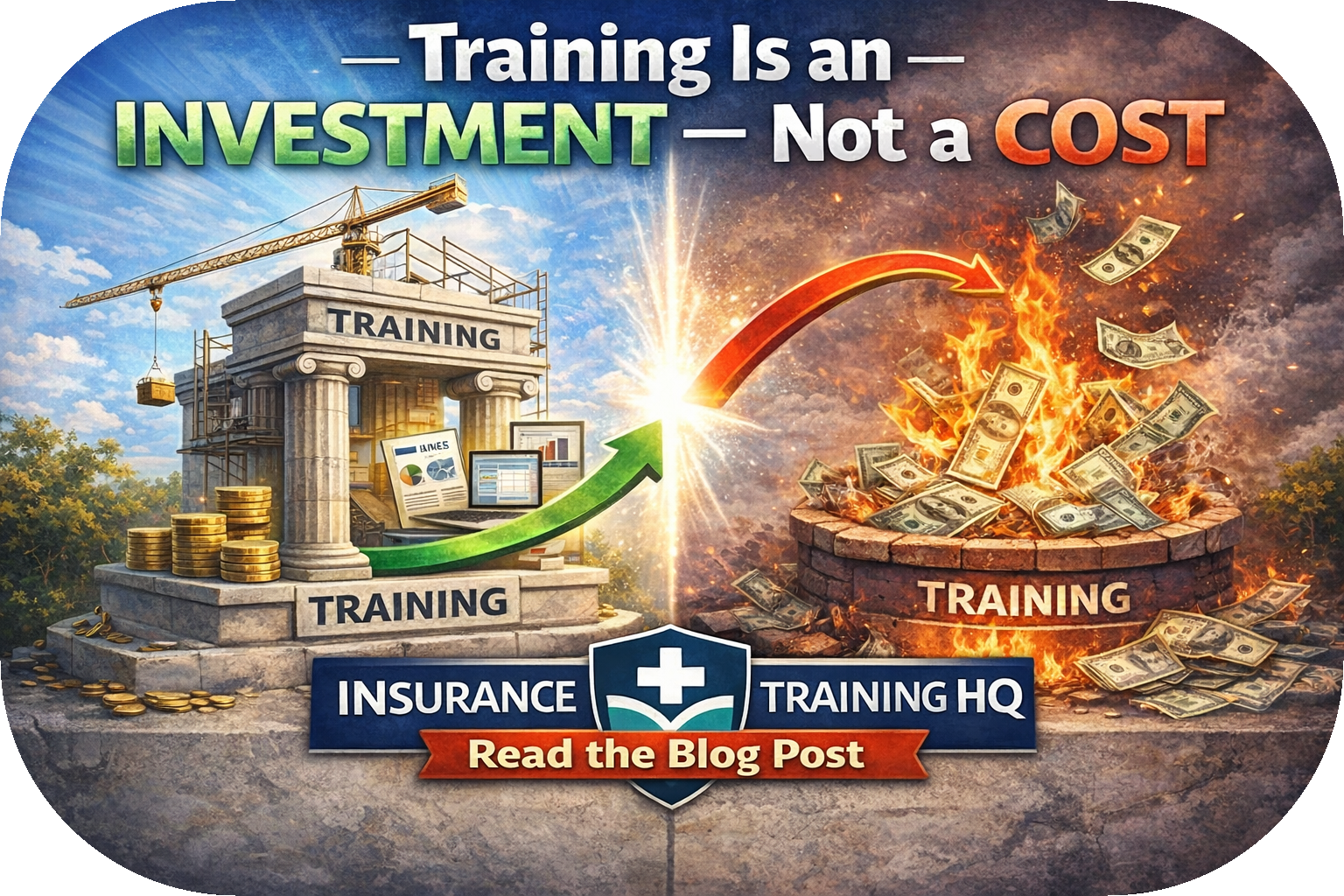
Back in March, I published a post called "Training Is an Investment, Not a Cost" and in it, I talked about why agencies need dedicated training teams and structured programs to support agent development from day one through their entire tenure. This post builds on that foundation. I want to take a step back and show you exactly why the world's biggest companies invest millions in training and what your agency can learn from their playbook, regardless of your size.
👋🏽My Personal Experience
I've been a trainer and educator in the Medicare space for the past seven years. In that time, I've built training teams, developed programs and content, and designed platforms for Medicare insurance agents across multiple organizations including Assurance IQ, Exact Medicare, and SeniorQuote, to name a few.
Those organizations ranged from small shops with fewer than 50 agents to large-scale operations with more than 6,000. Each one had different training needs based on size and agent ramp planning but the framework for how great training should be built was remarkably consistent across all of them.
Effective agent training programs are designed to:
Maximize agent adoption of the material being taught
Improve performance and adherence to compliance standards
Reduce early attrition and retain more agents longer
Build agent confidence and deepen product knowledge
Help agents handle client needs quickly, accurately, compliantly, and professionally
I won't walk through my full training development model here but if you're interested in what Insurance Training HQ can do for your organization, let's talk. I'd love to walk you through it.
Before joining Assurance IQ, I worked with a couple of smaller Medicare agencies, and those experiences shaped everything I believe about what training can and can't do for an organization.
The first company I joined put me through a month-and-a-half onboarding program. It was thorough. It covered the products we'd be selling, compliance standards, performance expectations, and more. From day one of selling, I hit my sales goals, compliance scores, retention rates, and placement rates month over month, right out of training. That program gave me an early career picture of what quality training actually produces.
Then the company lost two key people: their experienced Trainer and their Site Director. Both were deeply knowledgeable about Medicare. Both were genuinely invested in agent success and in doing right by clients not just closing enrollments. When those two left, it was the beginning of the end for that call center.
The replacement trainer was combative, unsupportive, and visibly uninterested in agent development. The company saw it and kept them anyway. I'd argue that decision was a major factor in what unraveled next. The trainer sets the cultural tone before an agent ever reaches their sales manager. If agents don't feel trained, supported, and valued in those first 30–60 days, you'll lose them at 60–90 days or at best, within one to two years. Since the company culture is driven by the leadership team and the site got a new Site Director that was also uninterested in agent development and sale quality this didn’t make thing better.
The second company was smaller, five to eight agents working out of a single office. The resources and financial backing weren't there, and it showed, but that’s okay we all have to start somewhere be build overtime.
At this company there was no dedicated trainer, no consistent onboarding program for new hires, and no mechanism for addressing compliance mistakes across the team when they happened. The focus was entirely on enrollment volume, not quality. The compliance posture was fast and loose, and leadership seemed comfortable with that.
When I joined, I saw it immediately. I partnered with the Sales Director and moved into a combined Sales Supervisor and Trainer role. From there, I built an agent onboarding program from scratch, created a Medicare Resource Guide that converted the Medicare & You handbook into an agent-facing reference tool for live calls, and implemented a call screening and coaching process to improve enrollment quality across the team.
Those changes worked. The agency expanded into a larger office and grew its agent count. My role eventually expanded to include Compliance Officer, Customer Service Manager, and Site Trainer.
The lesson I took from that experience: proactive training — having quality resources, reference tools, and support systems in place before problems occur is what keeps compliance manageable. When you're reactive, compliance isn't coaching anymore.
It's a decision: terminate the agent or retrain them. Neither option is cheap, and neither should be the first resort.
With that context in mind, let's look at what the largest companies in the world are doing and what every Medicare agency can take from it.
🏢 What Big Companies Are Actually Doing
Let's look at what some of the world's largest employers have committed to training and workforce development in recent years because the scale of these investments says something important.
Walmart committed $1 billion toward a skills-first development strategy, focused on building frontline employees into career-track professionals through structured learning pathways.
Amazon has put more than $1.2 billion toward upskilling over 350,000 U.S. employees through its Career Choice program with a specific focus on preparing workers for higher-demand roles inside and outside the company.
Microsoft launched a $4 billion AI skills initiative aimed at credentialing 20 million people globally, because they recognized that their workforce and their customers' workforces would need new capabilities to remain competitive.
UnitedHealth Group has committed over $156 million in direct and facilitated investments in workforce development programs since 2020, supporting nearly 5,500 individuals in joining or advancing careers in health care.
Humana invested $23 million in its own employees through tuition assistance, reimbursements, and certifications to support education and upskilling.
These aren't companies in survival mode. They're profitable, globally recognized organizations that could justify doing less. Instead, they're doing more and they're doing it intentionally.
🎯 Why They're Doing It — The Business Case Behind the Investment
When a company the size of Walmart commits $1 billion to training, it's not an act of charity. It's a business decision backed by data.
Here's what the research consistently shows:
On Profitability: Companies that invest in workforce development report, on average, 11% higher profitability and they're twice as likely to retain their employees compared to organizations that don't.
On Productivity: Organizations with comprehensive training programs yield up to 218% higher income per employee than those without structured learning.
On Retention: LinkedIn's Workforce Learning Report found that 93% of employees say they would stay longer at a company that invests in their development. Nearly 90% of millennials consider professional growth and development a top priority when evaluating where to work.
On Turnover Cost: Replacing an employee costs, on average, between 50% and 200% of their annual salary depending on the role, ramp time, and institutional knowledge lost. For a Medicare agency losing producers in their first 90 days, that math gets expensive fast.
Large companies aren't investing in training because it's altruistic. They're investing because every dollar spent developing their people returns multiples on the back end in retained talent, increased production, and reduced risk.
🤔 "That's for Billion-Dollar Companies. I Run a Small Agency."
Fair.
But here's what I'd push back on:
The principle behind these investments doesn't change based on company size. The execution changes. The budget changes. But the reason they work doesn't.
When UnitedHealth Group commits $156 million to workforce development, they're not doing it out of goodwill they're doing it because a more capable, better-trained workforce delivers cleaner outcomes, stronger retention, and lower risk across their entire operation. The same logic applies inside your agency.
When Humana invests $23 million in a single year to upskill its own people, the message is clear: even organizations that already employ thousands of credentialed professionals believe ongoing development is non-negotiable. If your carriers are investing in their own teams at that level, your agents, the people representing those carriers in the field, deserve the same standard.
When Walmart builds structured learning pathways for frontline workers, the goal is the same thing every Medicare agency needs: get people productive faster, keep them longer, and reduce preventable mistakes.
When Amazon invests in upskilling, the goal is the same thing every agency leader should want: a team that doesn't become obsolete when the environment changes and Medicare changes every single year and sometimes throughout the year.
When Microsoft builds AI literacy into its workforce, the underlying belief is the same belief every forward-thinking agency leader should hold:
The team that learns the fastest wins.
You don't need a billion dollars to act on that belief.
You need a plan. You need consistency. And you need to treat training as infrastructure, not as something you do when you have extra time.
🛠️ What You Can Borrow (Right Now)
You don't need to replicate Walmart's program. But you can borrow the thinking behind it and apply it at the scale your agency operates today.
Here's how the big-company principles translate to a Medicare agency:
Build a structured onboarding pathway — not just a checklist. Large companies don't hand new hires a binder and say "good luck." They build sequenced learning journeys that take people from "new" to "confident" in a defined window of time. Every agency, regardless of size, can build a 30-day onboarding roadmap that covers system navigation, product knowledge, compliance expectations, and the sales process, in that order.
Invest in ongoing development, not just initial training. The companies above didn't commit billions to one-time onboarding. They built systems for continuous learning. In a Medicare agency, that might look like a weekly 30-minute or longer team learning session, a library of job aids agents can pull mid-call, or a monthly refresher on compliance updates. The format doesn't have to be expensive it has to be consistent.
Separate training from management. One of the most consistent traits of companies with strong training cultures is this: They don't ask managers to carry the training function alone.
Sales Managers drive performance.
Trainers build competency and .
In a small agency, those roles may overlap but the responsibilities shouldn't. When training becomes a secondary responsibility of a production-focused manager, it becomes the first thing cut when the calendar fills up.
Upskill before the change arrives. Amazon didn't wait until its workforce was obsolete to invest in new skills. Medicare changes annually election periods, plan benefits, commission structures, compliance expectations. Agencies that train ahead of those changes outperform agencies that scramble to catch up during AEP.
Treat retention as a training outcome. Every company on that list is investing in training specifically because it reduces turnover. Retention isn't just a recruiting or compensation issue in Medicare agencies it's a training issue. Agents who understand what they're doing, feel supported in doing it, and see a path to growth don't leave as quickly.
⚖️ The Principle That Scales to Any Size
Here's what every organization on that list understands and what I want every agency leader reading this to internalize:
Training is not something you do for people. It's something you build with them so your organization can grow.
Walmart doesn't invest in its workers because it's generous. It invests because a well-trained associate makes fewer errors, serves more customers, and stays in their role longer all of which protect margin and growth.
The same logic applies to a Medicare agency with any number of agents.
When your agents are trained:
Enrollments are more accurate
Compliance risk decreases
Chargebacks and CTMs go down
Clients get placed in the right plans
Agents build confidence and stay longer
You spend less time correcting and more time growing
Training doesn't cost your agency money in the long run.
The absence of training does.
🏗️ The Bottom Line
The world's largest employers aren't investing billions in training because they have money to burn.
They're doing it because they've run the numbers and the numbers are clear.
Developed people perform better, stay longer, make fewer mistakes, and build stronger organizations around them.
You don't need a billion-dollar budget to apply that truth.
You need a structure. A system. And a commitment to treating your agents like the long-term investment they actually are.
💪 Ready to Build Your Training Strategy?
If you're an agency leader who's been running on instinct and hoping training will work itself out this is the moment to change that.
Schedule an Agent Success Strategy Call with Insurance Training HQ, its designed to:
Review your current training structure (or the absence of one)
Identify where knowledge gaps, compliance risk, and early attrition are costing you
Build a practical roadmap you can start implementing immediately without disrupting production
You don't need to build a training department from scratch.
That's what we're here for.
Check out some of our past blogs!