

Insurance Training HQ – January 2026 Newsletter
Supporting Medicare agents learn, grow, and sell with confidence.
👋 Welcome & Introduction
Hello, and thank you for joining the Insurance Training HQ Newsletter.
This is our first newsletter of 2026, and we’re excited you’re here.
On January 5, 2026, we officially launched Insurance Training HQ with one clear focus:
to support Medicare insurance agents, and the agency leaders who train, manage, and support agents in navigating an increasingly complex Medicare landscape.
For agents, we focus on strengthening Medicare knowledge, confidence, and readiness to sell, so they can better serve clients, stay compliant, and grow.
For agency leaders and sales managers, we focus on training strategy, program development, and operational support, helping organizations build scalable onboarding, education, and coaching frameworks that improve agent performance and retention.
Through a combination of e-learning, live education, coaching, and consulting, Insurance Training HQ bridges the gap between agent education and organizational training strategy—so both agents and leaders are equipped to succeed.
📰 About This Newsletter
This monthly newsletter is designed to keep you informed on:
What Insurance Training HQ is building and releasing
Key Medicare updates and regulatory changes
Industry insights and data worth paying attention to
Observations and discussions shaping the future of Medicare
From time to time, we’ll also publish opinion-based blog content, focused on:
Why Training Matters (for agency leaders)
Industry changes impacting agents and leadership
Medicare knowledge, sales, and compliance insights for agents
Lastly, we’ll provide this information in text and audio format to make it easier to digest!
🏗️ What We’re Building in 2026
This year is about building strong foundations.
Our focus for 2026 is developing the core infrastructure that will support both individual agents and agency leadership long term.
🧠Agent HQ (Learning Platform for Agents)
Agent HQ is our upcoming Learning Management System (LMS) designed specifically for Medicare insurance agents. The goal is to provide accessible, practical Medicare education that agents can use anywhere—regardless of the organization they work with.
What Agent HQ will include:
Limited free e-learning courses for aspiring agents
Structured courses to help agents understand the Medicare landscape
Medicare Level 100: Core Foundations Series
Downloadable Knowledge Guides & Job Aids
Short- and long-form video library
Live webinars and educational sessions
🧭 Agent Success Strategy (Consulting for Agency Leaders)
Agent Success Strategy is our consulting arm, built for sales managers and agency leaders looking to improve agent performance through training and structure.
Services include:
Private consulting services
Medicare subject matter expert guidance
Training program development
Plug-and-play training solutions
Bespoke content creation
Training facilitation
Agent sales coaching
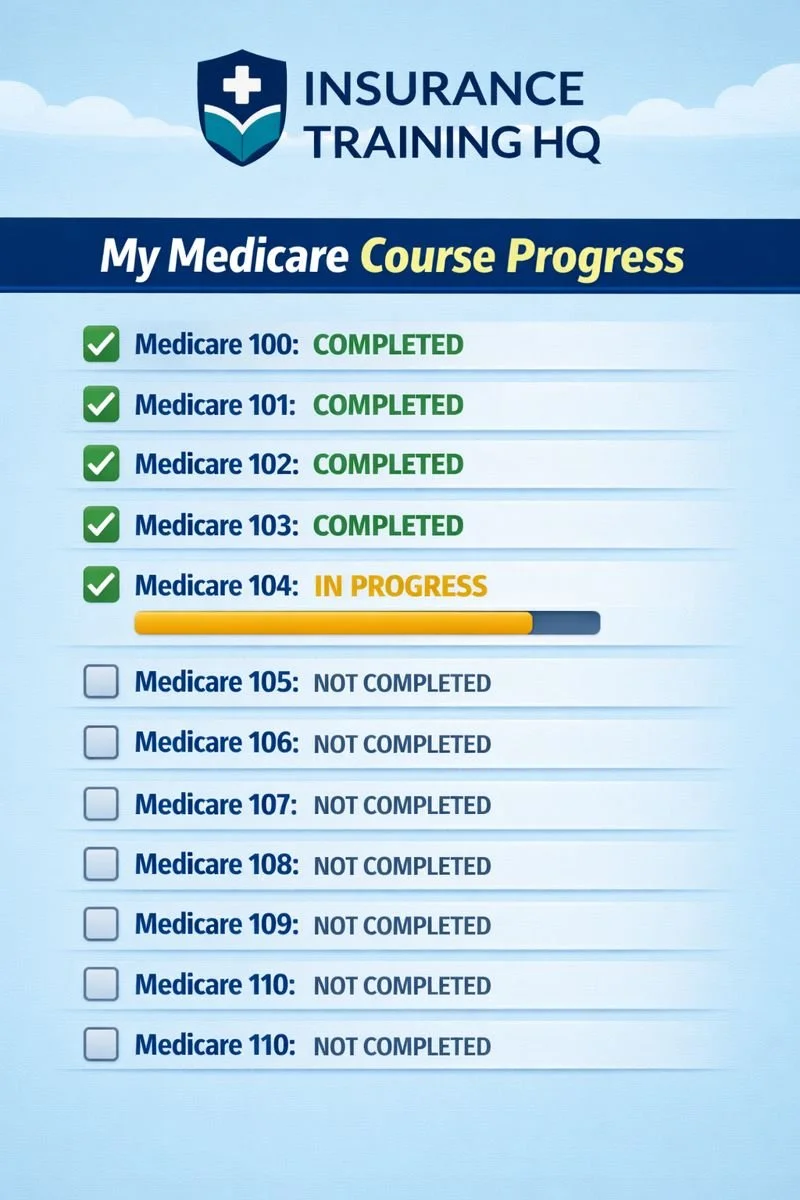
🎓Medicare Level 100: Core Foundations Series - Progress Update
Big news: our Medicare Level 100 certification series is coming soon.
We’ve already completed Medicare 100 through Medicare 103 (four courses), and we’re actively developing a 10-part e-learning certification designed to help agents become confident, competent, and prepared to sell Medicare products responsibly.
What it covers
Clear, easy-to-follow lessons on:
Medicare Part A & B
Medicare Advantage (Part C)
Prescription Drug Plans (Part D)
Medigap
Election Periods
Practical guidance on helping clients choose appropriate coverage
Clear explanations of plan interactions and enrollment timelines
What it doesn’t (yet)
This series focuses on product knowledge and enrollment mechanics.
Medicare compliance and compliant sales practices are not included in Level 100, but a dedicated sales compliance module is planned immediately following the Level 100 rollout.
Access & pricing
Agent HQ Plus members: Full access included
Agent HQ Light members:
Upgrade to Plus for ongoing access
Purchase the full Medicare Level 100–110 series as a one-time premium.
Why this matters
This certification is designed to build agent confidence, improve client conversations, and support stronger, more compliant sales outcomes. Whether you’re brand new to Medicare or refreshing your knowledge, the Level 100 series gives you the practical, up-to-date training you need to serve clients better and grow your business.
17 Outpatient Services Requiring Prior Authorization:
Skin and tissue substitutes
Nerve stimulators and stimulation devices
Epidural steroid injections for pain management (excluding facet joint injections)
Cervical fusion procedures
Knee arthroscopy for osteoarthritis (arthroscopic lavage and debridement)
Incontinence control devices
Diagnosis and treatment of impotence
Percutaneous image-guided lumbar decompression for spinal stenosis
Percutaneous vertebral augmentation (PVA) for vertebral compression fracture
Blepharoplasty, blepharoptosis repair, and brow ptosis repair
Botulinum toxin injections
Panniculectomy
Rhinoplasty
Vein ablation procedures
Repetitive scheduled non-emergent ambulance transport
Power mobility devices (PMD) and accessories
Osteogenesis stimulators
🆕 2026 WISeR Pilot Program
New for 2026: CMS is launching a six-year pilot program called the Wasteful and Inappropriate Service Reduction (WISeR) Model, which will introduce prior authorization requirements for Original Medicare beneficiaries. The prior authorization requirements will apply to 17 outpatient services in six states.
6 Pilot States Include:
Arizona
New Jersey
Ohio
Oklahoma
Texas
Washington
The services targeted are those identified as high-risk for waste, fraud, and abuse or that may pose safety concerns if delivered inappropriately
📃Medicare’s Proposed Final Rule for 2027
In late November 2025, CMS published proposed changes to the Medicare Part C, D, and Cost Plan Program for 2027.
Before diving into the details, a few important timing notes:
The Final Rule is typically released mid-year
This usually occurs before AHIP 2026–2027 certification
Implementation would apply to Contract Year 2027 marketing, beginning October 1, 2026
These changes would impact AEP 2026–2027 and beyond
Below, we’ll highlight proposed changes that may impact agents. Where possible, we’ll link directly to the CMS source so you can review and interpret the language yourself.
This information is shared for educational purposes only and does not replace compliance or legal guidance.
📜 Proposed Changes:
-
Link: Updates to the Star Rating Methodology
CMS is proposing to simplify and refocus the Star Ratings program, including changes to which measures are included, with the goal of improving enrollee health outcomes while reducing complexity.
CMS is proposing not to move forward with the Health Equity Index (Excellent Health Outcomes for All) reward, and instead to continue using the existing historical reward factor within the Star Ratings methodology.
Why this may matter:
Changes to Star Ratings can influence plan quality scores, benefits, and market positioning—factors that affect how agents present plans and how agency leaders evaluate carrier performance.
-
Link: Clarifying Allowable Hemp-Based SSBCI Benefits
CMS is proposing to clarify which cannabis-related products are not allowable as Special Supplemental Benefits for the Chronically Ill (SSBCI), specifically limiting the prohibition to cannabis products that are illegal under federal or state law.
Under this proposal, certain hemp-derived food products (hulled hemp seed, hemp seed protein powder, and hemp seed oil) may be allowed as SSBCI, if they:
Meet the federal definition of hemp,
Are legal under applicable state law,
Comply with FDA rules, and
Have evidence showing a reasonable expectation of improving or maintaining health for chronically ill enrollees.
Why this may matter:
This clarification could allow MA plans to expand nutrition-related SSBCI offerings, while maintaining a clear prohibition on marijuana or other illegal cannabis products. Agents and leaders may see new or refined supplemental benefits, depending on plan design and state law.Key Clarifications:
Marijuana and high-THC products remain prohibited and cannot be offered as SSBCI.
-
Link: New SEP for Provider Terminations (Replacing “Significant Network Change” SEP)
CMS is proposing to replace the current SEP for “Significant Change in Provider Network” with a broader Special Enrollment Period (SEP) for Provider Terminations, removing the need for CMS to first determine whether a network change is “significant.”
Under the proposal, any enrollee affected by a provider or facility termination—defined as having received care from that provider within the past 3 months—would be automatically eligible for an SEP.
Why this may matter:
This would make it easier and faster for affected beneficiaries to change plans or return to Original Medicare when their provider leaves a plan’s network.How the Proposed SEP Would Work
The SEP would begin the month the enrollee is notified of the provider termination and continue for two additional calendar months.
Enrollees could use the SEP once per provider termination.
Beneficiaries could attest directly to the plan that they were affected, rather than having to contact 1-800-MEDICARE.
Affected beneficiaries may enroll in another MA/MAPD plan or disenroll to Original Medicare with PDP coverage.
-
Link: Streamlined Notices to Enrollees
CMS proposes to combine provider termination notices and SEP notices into a single communication to affected enrollees. The notice would now be required to include:
SEP eligibility details (start and end dates)
Information on AEP and MA Open Enrollment Period
Medigap guaranteed issue (GI) rights
A reminder for employer/union members to check with their benefits administrator before changing coverage
Why this may matter:
This could reduce confusion for beneficiaries and simplify compliance workflows for plans and agencies.
-
Link: Updates to TPMO Disclaimer Timing & Content
CMS is proposing to change when TPMOs must verbally deliver the required disclaimer during sales calls, moving it from within the first minute of the call to before any discussion of plan benefits.
CMS is also proposing to remove State Health Insurance Assistance Programs (SHIPs) from the TPMO disclaimer, leaving Medicare.gov and 1-800-MEDICARE as the primary external sources referenced.
Why this may matter:
This change is intended to improve call flow and clarity for beneficiaries, while maintaining transparency about plan availability.What Is Not Changing - TPMOs would still be required to:
Use a standardized disclaimer
Display the disclaimer on websites
Include the disclaimer in marketing materials
Provide the disclaimer through electronic communications (email, chat, etc.)
What Counts as a “Discussion of Benefits”?
General statements (for example, “most MA plans offer dental”) do not trigger the disclaimer.
Plan-specific benefit discussions intended to influence enrollment do trigger the requirement.
-
Link: Removing Certain Rules on Timing & Manner of Beneficiary Outreach
CMS is proposing to remove certain prescriptive rules governing the time and manner of beneficiary outreach by MA organizations, Part D sponsors, and their agents and brokers.
The goal is to create a more flexible, beneficiary-friendly outreach experience while reducing regulatory burden on plans, agencies, and agents.
Why this may matter:
This proposal could allow for more natural, less rigid communication practices, while still maintaining core beneficiary protections.
-
Link: Allowing Marketing Events Immediately After Educational Events
CMS is proposing to remove the 12-hour waiting period between an educational event and a marketing event held in the same location.
Under the proposal, marketing events may take place immediately after educational events, provided beneficiaries are:
Clearly informed that the educational event is ending and a marketing event is beginning, and
Given a sufficient opportunity to leave before the marketing event starts.
Why this may matter:
This change could make it easier and more convenient for beneficiaries to access plan-specific information without needing to return at a later time or travel to a different location. Sales and marketing activities remain prohibited during educational events.What Would Be Required, If finalized:
Clearly notify attendees of the transition from an educational event to a marketing event (for example, a verbal announcement or written agenda).
Provide a meaningful break (such as a short restroom or refreshment break) so beneficiaries can leave if they choose.
-
Link: Allowing Scope of Appointment (SOA) Forms at Educational Events
CMS is proposing to allow plans and agents/brokers to collect Scope of Appointment (SOA) forms at educational events, reversing the prohibition finalized in 2023.
Collecting an SOA at an educational event would be permitted as long as no sales or marketing occurs during the educational event itself.
Why this may matter:
This would make it easier for beneficiaries to schedule follow-up marketing appointments without needing to reconnect later or return to the event location.
-
Link: Eliminating the 48-Hour Waiting Period After Scope of Appointment (SOA) Completion
CMS is proposing to eliminate the 48-hour waiting period between completing a Scope of Appointment (SOA) and holding a personal marketing appointment.
If finalized, agents and plans would still be required to obtain and document an SOA in advance, but no specific waiting period would be required before discussing plan options.
Why this may matter:
This would allow beneficiaries to discuss plan options on their own timeline, rather than waiting two days, which CMS believes created unnecessary access barriers without clear consumer protection benefits.
-
Link: Shorter Retention for Marketing & Sales Call Recordings (TPMO Oversight)
CMS is proposing to reduce the required retention period for the marketing and sales portions of recorded calls from 10 years to 6 years for MA organizations and Part D sponsors (including calls handled by TPMOs).
Enrollment records would still be retained for 10 years, and plans would still be required to record and retain the enrollment portion of phone enrollments as proof of the beneficiary’s intent to enroll.
Why this may matter:
This proposal reduces storage and administrative burden while keeping recordings recent enough for complaint investigations and oversight.
📨 CMS Request for Information on:
-
Link: Growth of Dually Eligible Enrollment in C-SNPs & I-SNP
CMS is requesting feedback on the rapid growth of dually eligible enrollment in C-SNPs, noting concerns that these plans do not integrate Medicare and Medicaid benefits the way D-SNPs do.
CMS is evaluating whether the growth of C-SNPs may be circumventing federal and state requirements that apply to D-SNPs and is seeking input on potential future policy solutions.
Why this may matter:
Future policy changes could affect SNP availability, enrollment strategies, and how plans serving dual-eligible beneficiaries are structured and offered.
-
Link: Marketing Oversight & Agent/Broker Regulation
CMS is seeking feedback on modernizing marketing oversight and agent/broker regulation, including potential changes to:
The definition and segmentation of TPMOs, to better distinguish roles, size, and scope.
The 5% translation requirement for non-English materials.
The requirement for CMS approval to use the Medicare card image.
Eliminating Outbound Enrollment Verification (OEV).
Modifying testimonial rules.
Eliminating certain mailing disclaimer statements.
-
Link: Accountability for “Bad Actors” & TPMO Oversight
CMS is exploring ways to better hold non-compliant TPMOs, agents, and brokers accountable, while avoiding unnecessary burden on compliant organizations.
CMS is seeking feedback on:
Aligning incentives in the agent/broker space
Improving training and testing requirements
Distinguishing between intentional misconduct and good-faith errors
Using data-driven monitoring to identify compliance risks
Why this may matter:
Agency leaders may see increased responsibility for oversight, training, and documentation, while agents could see changes in expectations around training, monitoring, and accountability.
📝Want to Submit a Comment?
CMS is currently accepting public comments on the proposed rule until January 26,2026
You can submit your comment using this link. (It should open the comment window automatically.)
As of now, over 11,500 comments have already been submitted. Early reviews suggest a wide range of perspectives from agents, organizations, and industry stakeholders.
What We’re Hearing From Public Comments
Below are several themes emerging from comments already submitted to CMS by agents, beneficiaries, industry professionals, and academics. These perspectives highlight where stakeholders feel the proposed rule is either moving in the right direction or may need refinement.
-
What commenters are saying:
C-SNPs and I-SNPs serve specific clinical or care-setting needs and were not designed to function like integrated D-SNPs.
Applying State Medicaid Agency Contract (SMAC) requirements to C-SNPs or I-SNPs could:
Delay market entry
Reduce plan availability
Disrupt care for high-risk populations
Commenters argue that dually eligible enrollment in C-SNPs often reflects access to condition-specific care, not confusion about integration.
-
What commenters are saying:
Seniors emphasize that Medicare Advantage provides:
Predictable costs
Continuity with trusted doctors
Benefits that support independence and preventive care
There is concern that unnecessary changes could introduce instability or disrupt care.
Commenters urge CMS to strengthen, not weaken MA, particularly around affordability and access.
-
What commenters are saying:
Strong support for:
Eliminating the 48-hour SOA waiting period
Allowing SOAs at educational events
Removing the 12-hour delay between educational and marketing events
Agents report these rules:
Reduced efficiency during short enrollment windows
Added friction without clear beneficiary protection benefits
Many see the proposed changes as restoring common-sense flexibility while keeping safeguards intact.
-
What commenters are saying:
Agents welcome the new SEP for provider terminations, especially the ability for beneficiaries to:
Work directly with an agent
Avoid routing everything through 1-800-MEDICARE
Some concern remains that:
Frequent network changes could lead to SEP misuse
Agents may struggle to track provider changes accurately
-
What commenters are saying:
Broad support for reducing call recording retention from 10 years to 6 years
Some stakeholders suggest:
Even shorter retention (5 or 3 years)
Retroactive application
Recognition that recordings are useful but most valuable when recent.
🚀 Looking Ahead to Medicare in 2026–2027
As we move through 2026 and look toward Contract Year 2027, it’s clear that CMS is signaling a shift in approach one that attempts to balance beneficiary protections with operational flexibility for plans, agencies, and agents.
Many of the proposed changes outlined above reflect themes we’ve consistently heard across the industry:
Reducing rigid timing rules that created friction without clear benefit
Preserving access and continuity of care for beneficiaries
Improving clarity in marketing and enrollment interactions
Maintaining oversight while acknowledging real-world operational realities
At the same time, CMS is using Requests for Information (RFIs) to test ideas that could shape future policy, particularly around:
SNP alignment and dual-eligible enrollment
Marketing oversight and TPMO accountability
Data-driven monitoring and quality measurement
It’s important to remember that these are proposed changes. The final rule is typically released mid-year and it may look different once CMS reviews public comments, industry feedback, and operational considerations.
For agents and agency leaders, this is an opportunity to:
Stay informed early
Share real-world experiences with CMS
Prepare for potential changes well ahead of AEP 2026–2027
We’ll continue monitoring this rulemaking process closely and will share updates as CMS releases additional guidance or final decisions.
Thank you for taking the time to read our first newsletter of 2026. We appreciate you being part of the Insurance Training HQ community and look forward to continuing these conversations with you throughout the year.
- Jay Sweat
Founder of Insurance Training HQ
Subscribe
〰️
Become a Member
〰️
Subscribe 〰️ Become a Member 〰️
Become a member while we are developing the platform!
Free membership - limited access to Medicare Training Resources. Check out some of our amazing benefits and services before becoming a Plus Member!
Get full access to our growing collection of training resources, webinars, workshops, and exclusive content. New items are added every month. Monthly membership - cancel anytime.